More Than Just HTML: Helping Students Believe in Themselves

I teach web development at a community college (Clark College), but let’s be real. Code is only part of the story.

What I teach is confidence, and occasionally, how to stop rage-AI-ing “why won’t my CSS center” at 11 p.m.

Many students show up thinking they’re not “tech people.” They doubt themselves before they’ve even typed <!DOCTYPE html>. Somewhere along the way, someone told them coding is only for hoodie-wearing geniuses or teenage YouTubers building apps in their sleep. I spend most of the quarter showing them that it is nonsense.

Yes, I teach HTML, CSS, JavaScript, Git, PHP, SQL, all the classics. But I also teach you how to fail forward, debug with a rubber duck, use vibe code when the plan falls apart, and not let a missing bracket ruin your day.

We talk about AI a lot because it is not going away. My students know it will not write their code for them, not if they want to pass, but they also learn how to ask it questions, get unstuck, and use it responsibly, like a teammate who never sleeps but sometimes gives wildly wrong advice with full confidence.

My favorite moments are when a student who started the class whispering, “I don’t think I belong here,” ends up staying after to help a classmate debug a form, slice of pizza in hand, casually explaining the event.preventDefault() as if it is no big deal.

Confidence is not something they walk in with. It is something they build: one messy project, one late-night aha moment, and one pizza-fueled study session at a time.

I just hand them the tools. And the duck. They do the rest.

From 48 to 62: A Teacher’s Journey Through Time and Tech

I’ve been thinking a lot lately as I get ready to turn 62 in July.
Thirteen years ago, at the age of 48, I began teaching Web Development at a community college. Back then, the age gap between my students and me didn’t seem like such a big deal. We connected easily. I was an experienced industry professional who still understood them.

Now? The gap feels wider. They’re teenagers and young adults, and I’m well, approaching retirement age. I’ve noticed that building trust, belief, and respect with students has become increasingly challenging. Not impossible, but different. I’m unsure if it’s me, them, the world, or how time works. Probably a little of all of it.

That said, I still see wins. I still have students who light up when they finally “get it,” who stick around after class to ask questions and tell me, months later, that something we discussed had a real impact. Those moments mean everything.
I’m sharing this because I know I’m not alone. If you’re a little (or a lot) older and working with younger generations, have you felt this too?

How are you bridging the gap? I’d love to hear your thoughts.

Now available! The Clark College Events Browser Extension

Drowning in event emails? Yeah, me too.

Working at the college means being constantly bombarded with emails about events, most of which get buried in our inboxes before we can even recall what they were about. So, I decided to put an end to the madness.
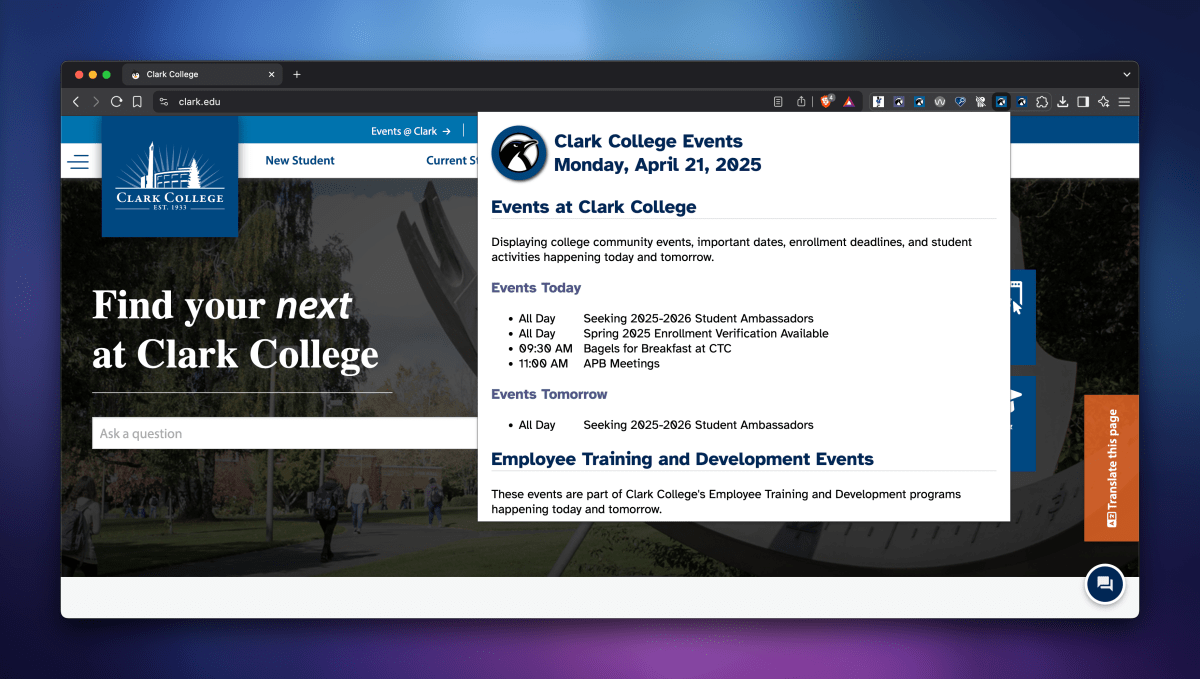
After carving out an hour (okay, maybe two), I built a Clark College Events browser extension that does one thing really well: shows you all of today and tomorrow’s events in one clean, easy-to-read place.

No more digging through email threads or clicking through scattered webpages. I discovered that each of the event pages has an RSS feed, so I connected the dots and bundled them up. Now, you can see everything in one tidy view.

Click on any of the events to access the corresponding event page on the website.

It’s simple, practical, and yes, it’s free. It’s also accessible.

Install it now

https://chromewebstore.google.com/detail/clark-college-events/kmafihepapkgalfjdgogcgloamkdlkpk?authuser=0&hl=en

My Winter 2025 Teaching Schedule at Clark College

Here are my courses and teaching schedule for the Winter 2025 quarter at Clark College. If you have any questions about these courses, please get in touch with me.

CTEC 127 – PHP with SQL 1 (Monday and Wednesday)

This class will have mandatory attendance at Clark College Room SHL 124 from 10:30 AM to 12:50 PM on Mondays and Wednesdays.

The following days meet, in person and have mandatory attendance:

  • Monday, January 6th (Week 1)
  • Wednesday, January 22nd (Week 3)
  • Wednesday, February 5th (Week 5)
  • Wednesday, February 19th (Week 7)
  • Wednesday, March 5th (Week 9)
  • Monday, March 15th (Finals Week)
  • All other scheduled class meetings will take place via remote learning on Zoom.

CTEC 270 – Web Interface Design 1 (Monday and Wednesday)

This class will have mandatory attendance at Clark College, Room SHL 124, from 3:00 to 4:50 PM on Mondays and Wednesdays.

The following days, meet in person and have mandatory attendance:

  • Monday, January 6th (Week 1)
  • Wednesday, January 22nd (Week 3)
  • Wednesday, February 5th (Week 5)
  • Wednesday, February 19th (Week 7)
  • Wednesday, March 5th (Week 9)
  • Monday, March 15th (Finals Week)
  • All other scheduled class meetings will take place via remote learning on Zoom.

CTEC 121 – Intro to Programming and Problem Solving (Tuesday and Thursday)

This class requires mandatory attendance at Clark College Room SHL 125 on Mondays and Wednesdays from 10:30 to 12:50 p.m.

The following days, meet in person and have mandatory attendance:

  • Tuesday, January 7th (Week 1)
  • Thursday, January 23rd (Week 3)
  • Thursday, February 6th (Week 5)
  • Thursday, February 13th (Week 6)
  • Thursday, February 27th (Week 8)
  • Thursday, March 13th (Week 10)
  • Tuesday, March 16th (Finals Week)
  • All other scheduled class meetings will take place via remote learning on Zoom.

CTEC 122 – HTML Fundamentals

This class if entirely online and never meets.

How Pizza and Rubber Ducks Bring Us Together in the Digital Classroom

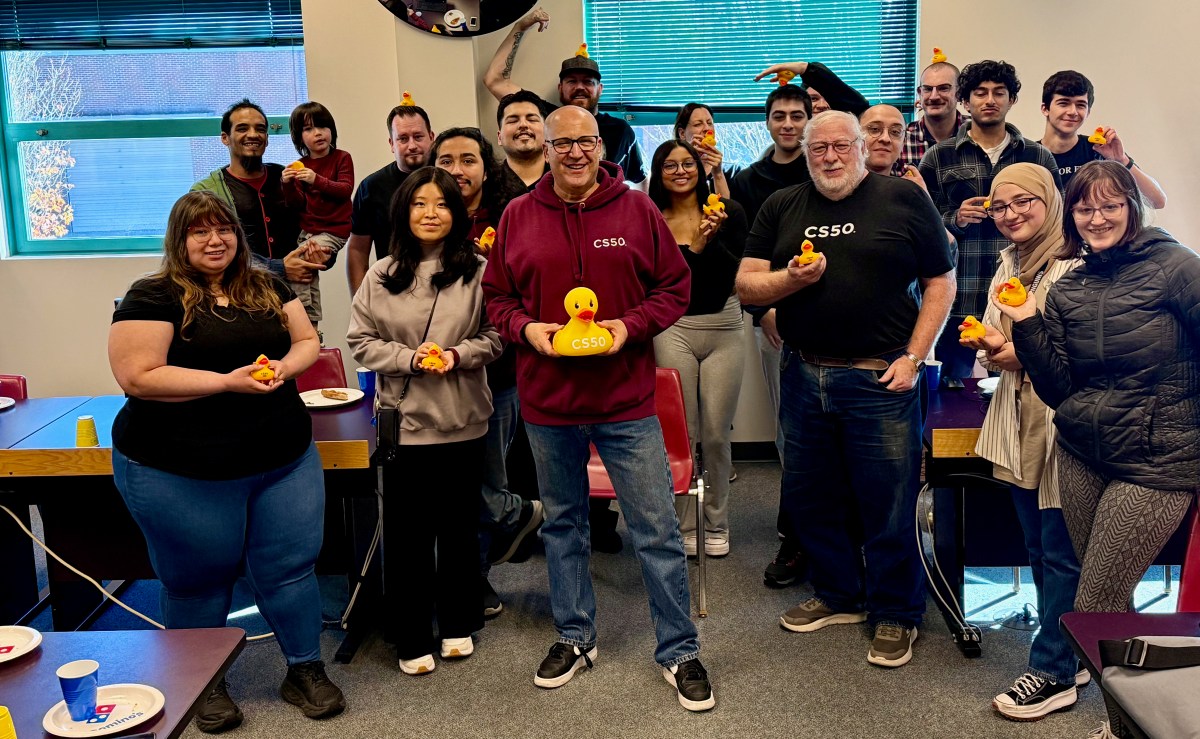
At Clark College in Vancouver, Washington, I recently brought a taste of community to our online and remote coding classes—through pizza and a little piece of the iconic CS50! This pizza party wasn’t just about food; it was a chance to unite students who usually connect only through screens. There’s something about sharing pizza that goes beyond filling our stomachs. It breaks down barriers, opens up conversations, and lets us see the human side of coding, a profession often steeped in virtual interactions and code blocks.

Pizza is almost a universal language, and even in a digital classroom, it creates a sense of camaraderie. From coding newcomers to seasoned tech enthusiasts, students gathered, laughed, and bonded over slices, sharing their coding challenges and side-hustles. Moments like these highlight the importance of community—reminding us that while we work individually, we’re part of a larger team learning and growing together.

And what’s a coding celebration without a twist? Each attendee walked away with a CS50 Rubber Duck. In case you’re wondering why a rubber duck, it’s not just a quirky gift—it’s a legendary problem-solving tool in coding circles! Rubber duck debugging encourages students to explain their code out loud, often helping them uncover solutions simply by verbalizing their thought processes. Now, every student has a little buddy to “talk” to while tackling their toughest challenges.

Katie Pierce Massey and Bruce Elgort

Whether solving bugs or sharing a laugh, we’re more connected, engaged, and inspired than ever. Here’s to pizza, ducks, and the strong coding community we’re building at Clark College!

Bruce Elgort and Dave Sims

Teaching CS50 in Community Colleges and Beyond

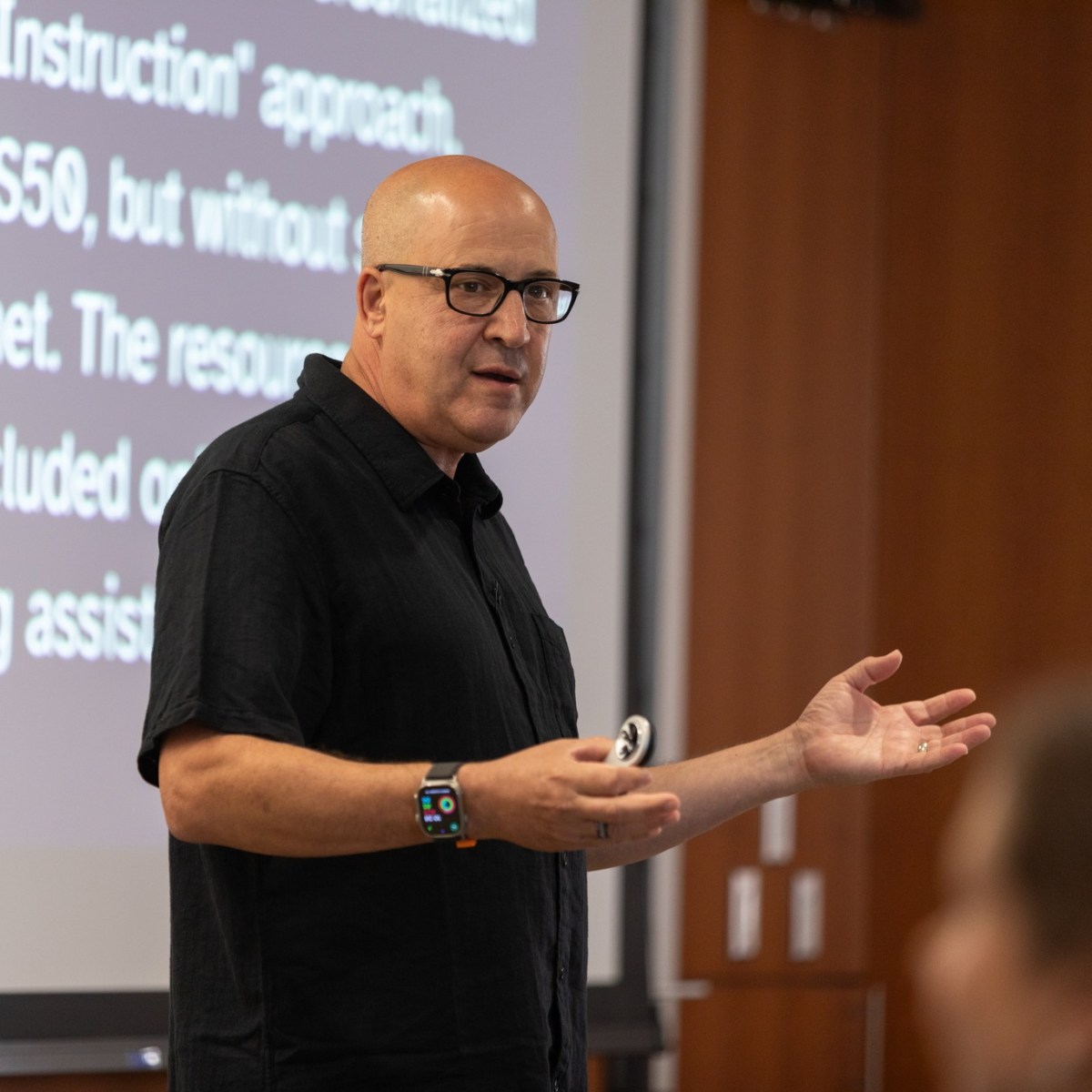
Earlier today, I gave a presentation at the Illinois Computer Science Summer Teaching Workshop entitled “Teaching CS50 in Community Colleges and Beyond.

Resources

Submission Tracker
Google Sheets-Based
https://bit.ly/submissiontrackercs50v2

Submission Downloader
with compare50 support
https://github.com/belgort-clark/multi-puller

CS50P Introduction to Programming with Python
https://cs50.harvard.edu/python/2022/

Session Abstract

Explore practical strategies for integrating Harvard University’s CS50P Introduction to Programming with Python into community college settings with insights from Bruce Elgort, a legally blind Computer Technology Professor at Clark College in Vancouver, Washington, USA. Bruce, renowned for teaching accessibility and universal design, seamlessly transitioned from the industry to teaching Web Development at the college. He blends material from CS50P with  TiLT (Transparency in Learning and Teaching) principles to help students along their guided pathways.

CS50 is Harvard University’s introduction to the intellectual enterprises of computer science and the art of programming, for majors and non-majors alike, freely available as OpenCourseWare.

Utilizing these approaches, Bruce has also taught CS50 at the graduate school level at Portland State University for students enrolled in Professional and Technical Writing. This 10-minute session, with 5 minutes dedicated to questions and answers, delves into tailored instructional methods and innovative curriculum designs inspired by the support model of CS50 at Harvard University. 

Learn about the CS50 tooling that aids instructors in optimizing resources, monitoring student progress, and customizing courses to meet diverse student needs, ensuring they are well-equipped for success in today’s technology-driven society. Join Bruce to uncover a forward-thinking approach to teaching CS50 at Clark College and beyond.